


TECH TALES at Vienna Design Week: case study
Written by Dillon Razlog
Room: Desiree
ANIMATION
The Desiree→ animation generated a strong positive response from the children. Several participants spontaneously described the animation as “melodic” and “like a song,” suggesting that the combination of sound and visual storytelling created an emotionally engaging and memorable experience.
From an educator’s perspective, the animation successfully supported an important principle of Social and Emotional Learning (SEL): emotional engagement can create a bridge into reflection and empathy. Rather than immediately asking children to analyse a character’s emotions intellectually, the sensory qualities of the animation appeared to draw them into Desiree’s world first. This provides an accessible entry point for younger participants who may find direct conversations about emotions or social stigma more difficult.
One area for development was the pacing and clarity of the interactive instruction. The animation felt slightly slow paced from the facilitator’s perspective, and it was not immediately clear to all participants when they were expected to interact with the snowflakes on the floor. Gentle facilitator prompting was enough to resolve this, and once the children understood the interaction, their enjoyment increased considerably.
This suggests that the experience itself was successful, but the transition between passive observation and active participation could be made more explicit. In an SEL environment, clarity is particularly important because uncertainty about what is expected can cause children to disengage or simply wait for others to act.
Potential modification: An image of the snowflake could be incorporated into the animation shortly before the interaction is required. Alternatively, the lighting system could be programmed to illuminate the relevant snowflakes at the precise moment children should interact with them. This would create a visual cue rather than relying primarily on verbal instruction.
This could also strengthen the children’s sense of agency and discovery: the environment itself communicates, “This is your moment to participate.”
INSTALLATION
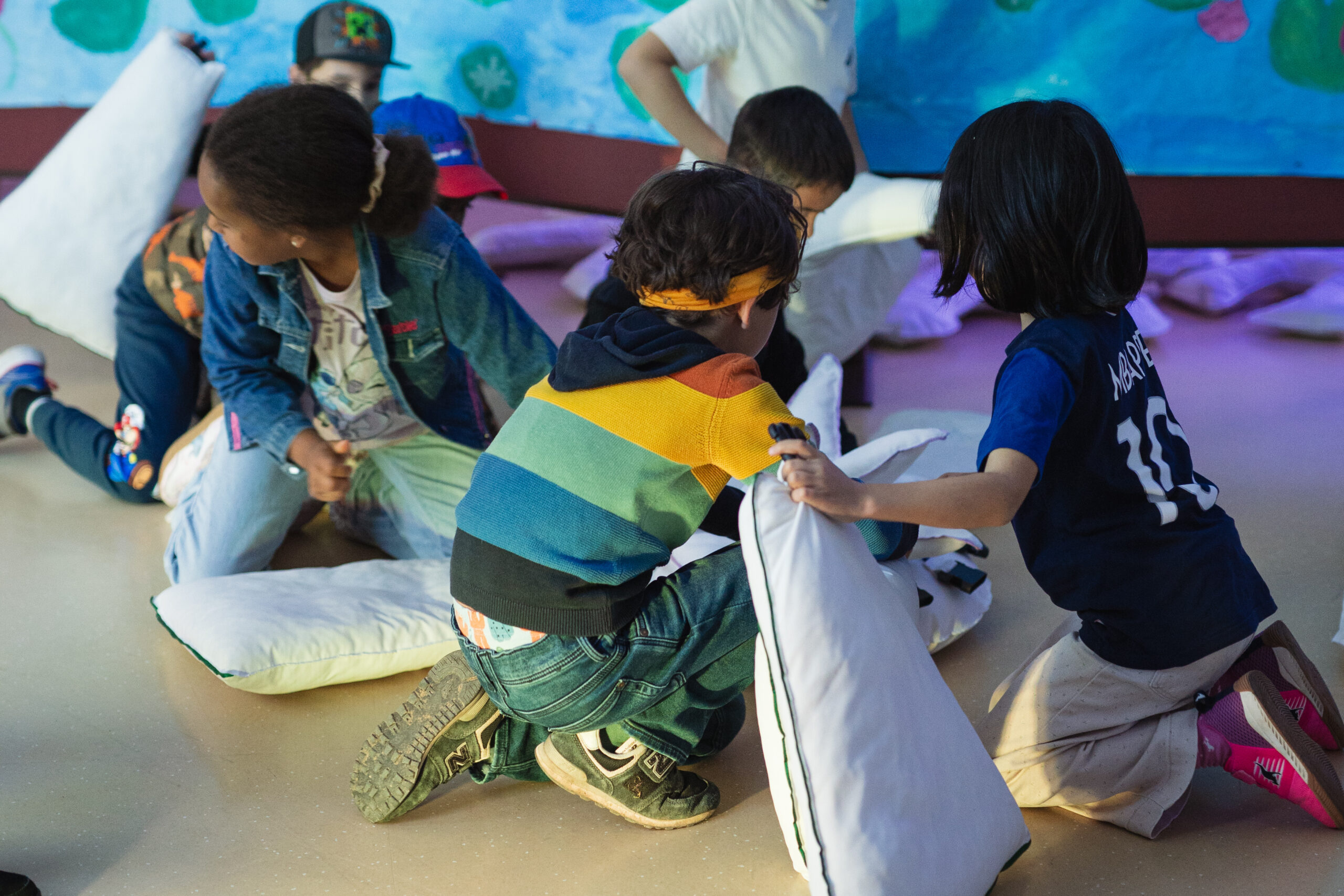
The Desiree installation worked very effectively as an interactive component. The children were highly curious and eager to explore it physically.
Interestingly, several children initially attempted to press the centre of the snowflake rather than interacting with it in the intended way. Rather than becoming a significant obstacle, this became an example of productive exploration. Through experimentation, observation and play, the children worked out how the installation functioned.
From an educator’s perspective, this is valuable because playful trial-and-error can support autonomy, problem-solving and confidence. Children were not simply given the correct answer; they were able to discover how the installation worked through their own actions.
This type of interaction is also relevant to SEL because it reinforces the idea that making a mistake does not necessarily mean failure. The environment allowed children to experiment without negative consequences, adjust their behaviour and try again.
For future iterations, the installation could retain this element of discovery while providing a very subtle physical or visual affordance that indicates where interaction is expected. The objective should not be to eliminate exploration, but to prevent unnecessary confusion.
KIDS’ ENGAGEMENT
Overall engagement with the Desiree room was very high. The children appeared enthusiastic about both the animation and the physical installation, and their spontaneous comments about the animation indicate that the experience created an emotional and sensory impression beyond simply completing an activity.
Engagement did, however, decrease slightly during longer periods of parts of the story. This is consistent with the needs of many younger learners: sustained attention can be more difficult when the experience shifts from active participation to extended listening.
There was also an environmental factor. The Frog exhibition next door created audible background noise, which occasionally competed for the children’s attention. This is particularly relevant in an exhibition environment where multiple immersive experiences are operating simultaneously.
From an educator’s perspective, this highlights the importance of considering sensory environment as part of the learning design. Children’s disengagement should not automatically be interpreted as a lack of interest in the subject matter; competing auditory stimuli can significantly affect attention and working memory.
Shorter discussion segments, more frequent opportunities for movement and interaction, and stronger visual cues could therefore help maintain engagement.
SEL & EMPATHY OBSERVATION
Desiree’s strongest educational potential lies in its ability to move children through a sequence of experience → curiosity → interaction → emotional reflection.
The room creates an opportunity to explore emotions without immediately placing children in the uncomfortable position of having to disclose their own personal experiences. This is particularly important when exploring stigma, difference and social belonging. Children can first discuss Desiree’s experience, creating psychological distance before potentially connecting the story to situations they recognise in their own lives.
This distance can make conversations about difficult subjects safer and more accessible.
A facilitator could build on this by asking questions such as:
→ What do you think Desiree might be feeling here?
→ What made you think she felt that way?
→ How might another person see the same situation differently?
→ What could someone do to make Desiree feel included?
→ Have you ever seen someone being treated differently because they were different in some way? What could a bystander do?
These questions move beyond identifying emotions and towards perspective-taking, empathy and prosocial action.
Importantly, the discussion should avoid positioning children as representatives of a particular identity or asking them to disclose personal experiences. The goal is to create a space where children can explore stigma safely through the fictional world of the character before connecting the themes to broader social situations.
EDUCATOR’S REFLECTION
The Desiree room demonstrated strong potential as an SEL-based immersive experience. The combination of animation, physical interaction and storytelling created high engagement and encouraged children to learn through exploration rather than instruction alone.
The primary opportunities for improvement are interaction clarity, pacing and environmental distraction, rather than fundamental changes to the concept.
For future exhibitions, small environmental cues could make the experience significantly more intuitive: visual indicators, synchronised lighting and shorter verbal explanations would allow children to spend more time experiencing and less time waiting for instructions.
From an educator’s perspective, the most valuable aspect of the room was that children were given the opportunity to enter a character’s world rather than simply being told about the character. This creates a strong foundation for empathy. With carefully facilitated discussion afterwards, the experience can move from entertainment into meaningful exploration of feelings, belonging, difference, stigma and how our actions affect others.
KEY RECOMMENDATIONS
Keep
→ Strong sensory and melodic animation;
→ Interactive snowflake installation;
→ Opportunities for discovery and experimentation;
→ High level of child participation;
→ Character-centred approach to exploring emotions.
Modify
→ Make the snowflake interaction visually explicit;
→ Synchronise lighting with interaction moments;
→ Consider slightly faster pacing during longer animation sequences;
→ Break longer discussions into shorter, interactive moments;
→ Reduce or acoustically manage competing sound from neighbouring exhibitions.
EDUCATIONAL OPPORTUNITY
Use Desiree as a starting point for exploring emotional literacy, perspective-taking, empathy, belonging and the social mechanisms of stigma, while allowing children to engage with these themes through the safety of a fictional character.
Room: Frog
ANIMATION
The Frog animation generated a very strong and sustained response from the children. They were visibly engaged with the animation and particularly enjoyed the artwork and visual storytelling. Importantly, the children did not experience the artwork on the back wall as separate from the narrative; they actively connected the visual elements to the story, demonstrating that the animation successfully supported narrative comprehension and imaginative engagement.
From an educator’s perspective, this connection is significant. When children are able to connect visual information with a character’s experiences, they begin to construct meaning rather than simply receive information. This can support emotional literacy and perspective-taking, particularly when the story presents a character who may experience difference, exclusion or misunderstanding.
The children’s ability to make these connections spontaneously suggests that the visual language of the Frog experience was accessible and meaningful. It provided a natural foundation for later discussion about what the character may be experiencing and how other characters might respond.
The strong engagement may also create an opportunity for the facilitator to move beyond questions such as “What happened?” towards questions that encourage empathy:
→ How do you think Frog felt at this moment?
→ What do you think Frog wanted the other characters to understand?
→ Why might someone treat Frog differently?
→ What could another character do to make Frog feel included?
This shifts the experience from story comprehension towards perspective-taking and prosocial thinking.
INSTALLATION
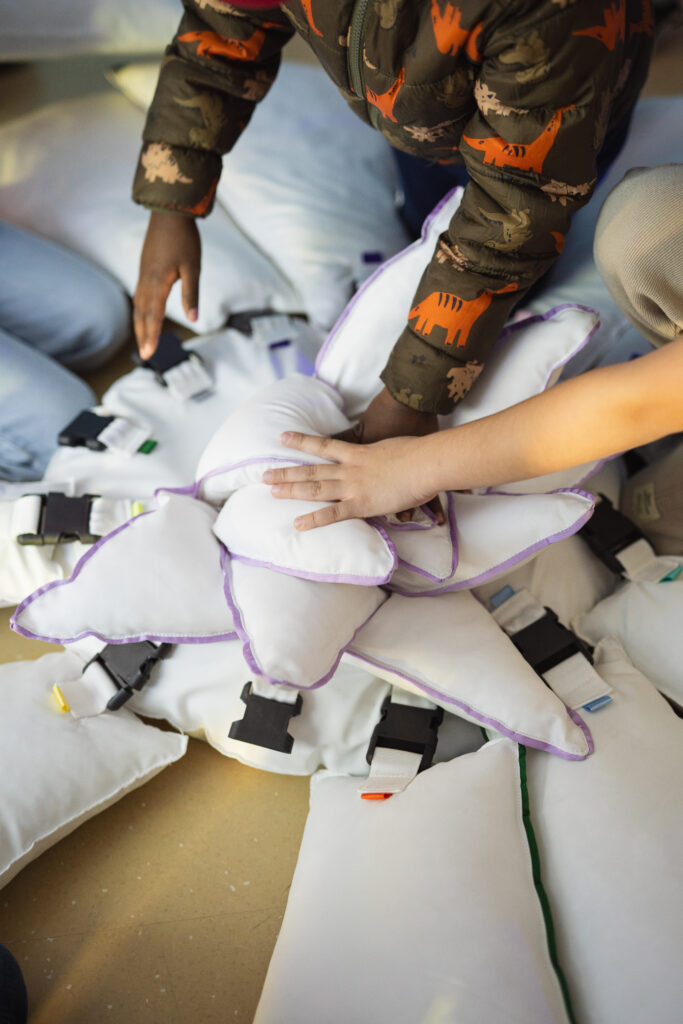
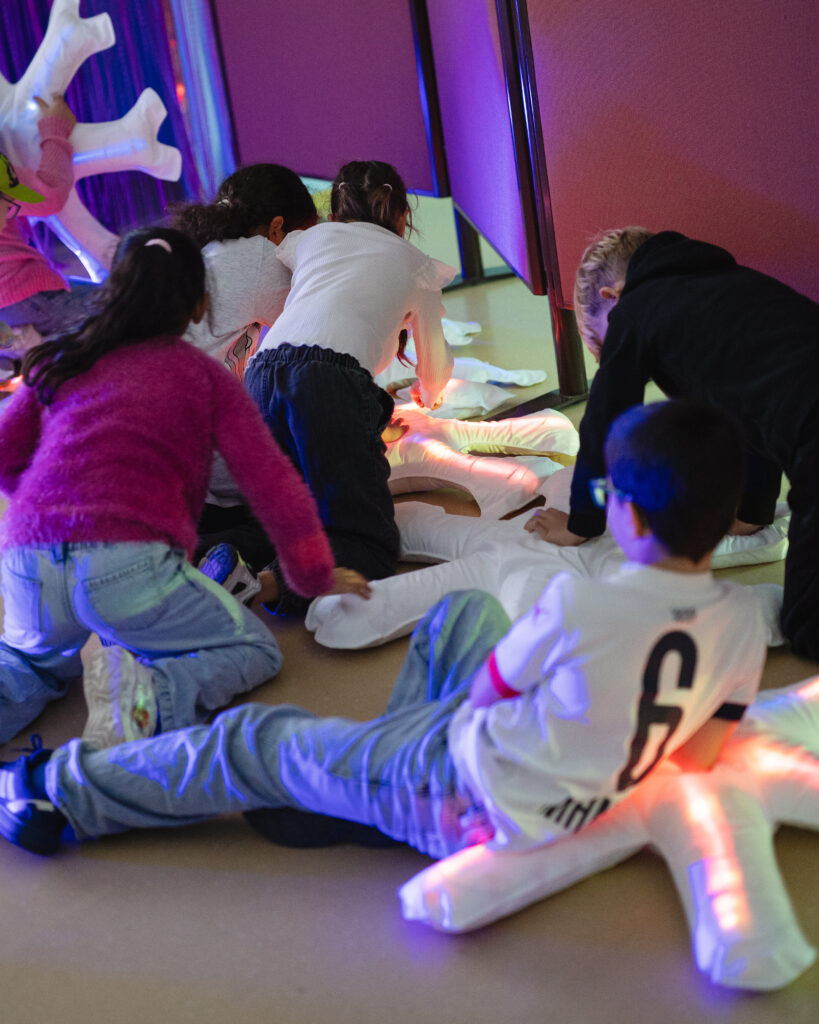
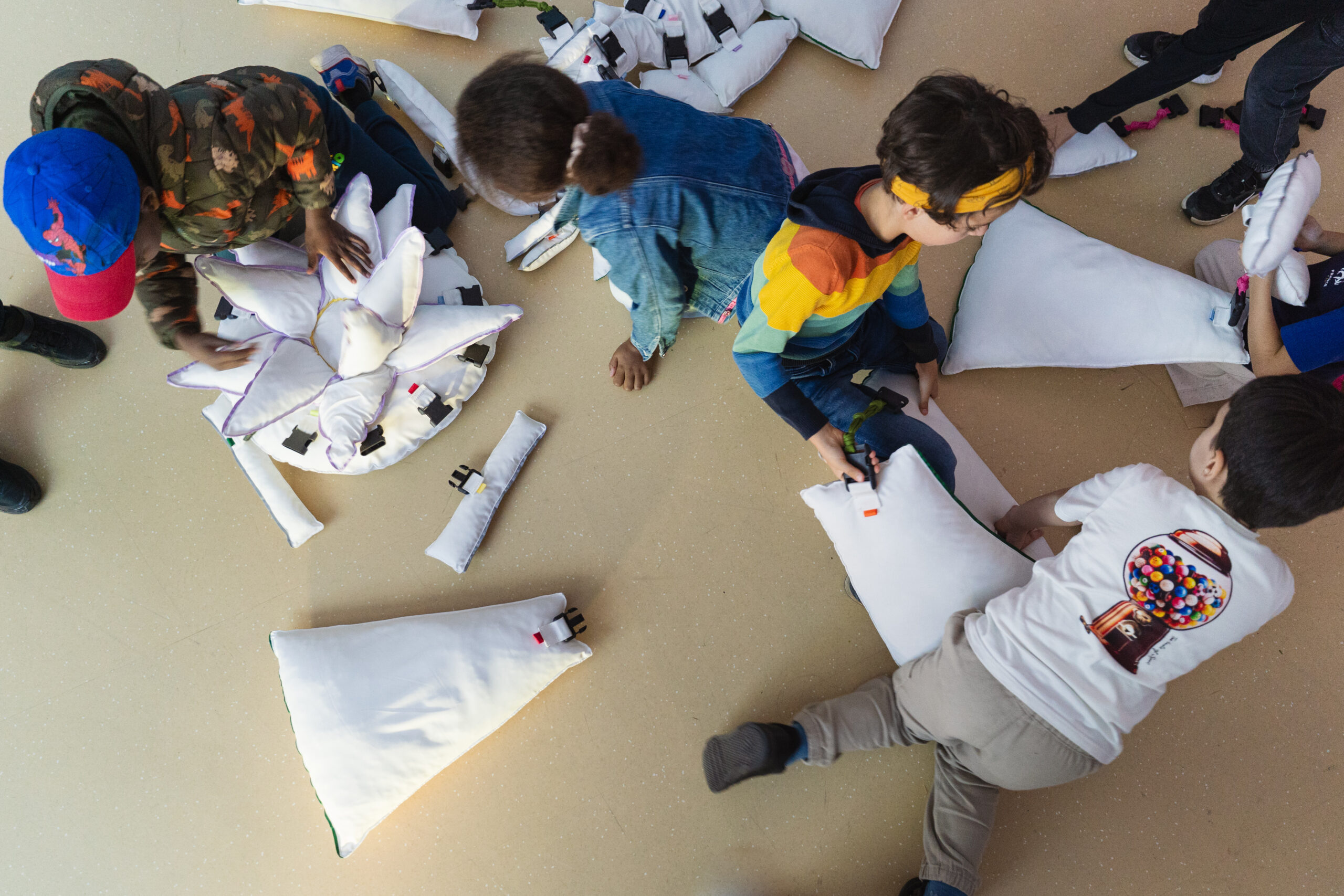
The Frog installation was highly successful in maintaining the children’s interest and encouraging active participation. The children clearly enjoyed interacting with the physical elements and demonstrated a willingness to experiment with the installation.
One area that required facilitator support was the colour coding between the lily leaves and lily flower and spoon. Children did not immediately understand the relationship between the colours, and a brief facilitator demonstration was needed before they could confidently proceed.
This is an important distinction from a lack of understanding of the activity itself. Once the relationship was demonstrated, the children were able to engage with the task. A stronger visual affordance could potentially make this relationship more intuitive and reduce the need for verbal explanation.
The clasps used to connect and disconnect the pieces also presented a minor physical challenge. Some children found them difficult to manipulate independently, meaning the facilitator needed to assist.
From an educational design perspective, the objective should be to ensure that the physical mechanism does not become more challenging than the cognitive or creative task. If children are spending significant attention trying to operate a clasp, this can temporarily shift their focus away from the story and creative objectives.
A future iteration could explore clasps that are easier for smaller hands to operate while retaining the sense of physical construction and discovery.
CREATIVE BUILDING & AGENCY
The third stage, involving free building and creation, presented an interesting opportunity for further development.
The children initially enjoyed the freedom to create, but the available connection options appeared somewhat limited. Once they had connected two elements, some children were unsure what they could do next and looked towards the facilitator for direction.
This suggests that the concept of open-ended play was strong, but the creative affordances could be expanded.
Rather than giving children a prescribed outcome, additional connection possibilities could allow them to construct more complex objects, characters or environments. For example, providing several types of compatible connection points or a larger variety of interchangeable pieces could encourage children to experiment with:
→ Combining multiple elements;
→ Creating their own characters;
→ Building environments;
→ Creating alternative solutions to the story;
→ Working collaboratively on a larger construction.
This would strengthen one of the most valuable aspects of SEL-based experiential learning: agency.
Children are not simply following instructions; they are given the opportunity to make choices, test ideas and create something that did not previously exist.
The facilitator could then use the creations as a bridge back into the emotional themes of the story:
→ “Tell me about what you created.”
→ “What could this character do to help Frog?”
→ “What would make this a safe place for everyone?”
This turns free play into a potential vehicle for empathy, inclusion and social problem-solving without making the children feel that they are being given a formal lesson.
KIDS’ ENGAGEMENT
Engagement throughout the Frog experience was very high.
The children maintained strong attention across the animation and installation and demonstrated enthusiasm for both the story and the physical elements. Their ability to remain attentive throughout the experience suggests that the combination of narrative, visual stimulation and hands-on interaction was particularly effective for this group.
Unlike some longer discussion-based experiences, the Frog room appeared to maintain attention because the children were consistently given something to observe, interpret or physically interact with.
The strong engagement also provides an opportunity to introduce more sophisticated SEL conversations without necessarily extending the length of the experience. Rather than adding substantially more verbal content, the existing engagement could be used to facilitate short, targeted reflective questions between activities.
This would preserve the momentum of the experience while deepening its educational value.
SEL & EMPATHY OBSERVATION
The Frog room has strong potential for exploring empathy, belonging, difference and social inclusion through play.
A particularly valuable feature is that the children were already connecting the physical artwork with the narrative. This creates a natural pathway from story → interpretation → emotional understanding → action.
The installation could therefore be used to explore not only how Frog feels, but also what the children believe others could do in response.
For example:
→ What do you think Frog needs from the other characters?
→ What would it feel like if nobody wanted to play with you?
→ How could you invite someone into your game?
→ Does being different always mean something is wrong?
→ What could we change about this world to make everyone feel welcome?
These questions can introduce the concept of stigma in an age-appropriate way. Rather than defining stigma academically, children can explore the experience of being judged, excluded or misunderstood because someone appears different.
The free-building component provides an especially powerful opportunity here. Children could potentially be invited to build a world in which everyone belongs, allowing them to translate an abstract social concept into something concrete and visible.
This also moves empathy beyond simply recognising someone’s feelings. The children begin to consider what they themselves can do in response, supporting the development of prosocial behaviour and social responsibility.
EDUCATOR’S REFLECTION
The Frog room demonstrated exceptionally strong engagement, with children responding positively to both the narrative and the interactive installation.
Its greatest strength was the relationship between storytelling and physical exploration. The children were not merely watching Frog’s story; they were using the installation to interact with the world of the character. This creates an excellent foundation for experiential SEL.
The main modifications required are relatively practical rather than conceptual. The colour coding should be made more intuitive, the clasps could be redesigned to make independent manipulation easier, and the free-building section could provide more possibilities for continued creation.
The latter could be particularly valuable. Once children have mastered the basic mechanics of the installation, the experience should ideally move from “Can I do this?” to “What can I imagine?”
That transition from instruction to imagination is where the installation could become even more powerful educationally.
The Frog room also demonstrates that SEL does not need to be delivered through lengthy explanations. Children can encounter empathy through story, practise agency through play and explore inclusion through creation. The facilitator’s role then becomes one of guiding reflection rather than delivering the message for them.
KEY RECOMMENDATIONS
Keep
→ Highly engaging animation;
→ Strong visual artwork;
→ Clear connection between animation and physical installation;
→ Hands-on interaction;
→ High sustained attention;
→ Opportunities for creative exploration.
Modify
→ Make lily leaf/lily flower colour coding more intuitive;
→ Simplify the clasps so children can connect and disconnect pieces independently;
→ Expand the number and variety of connection possibilities in the free-building stage;
→ Provide enough components to encourage multi-step or collaborative construction;
→ Use brief facilitator prompts rather than extended explanations.
EDUCATIONAL OPPORTUNITY
Develop the free-building stage into a stronger empathy and inclusion activity by inviting children to create solutions within Frog’s world: a place where Frog feels welcome, a character who helps Frog, or a new environment where differences are accepted.
This would allow the room to move naturally from understanding a character → imagining their perspective → creating a solution → thinking about inclusion in the real world.
Room: Allen
ANIMATION
The Allen→ animation generated very high enthusiasm and sustained attention from the children. A particularly successful element was the unexpected appearance of the secret genie from the lamp. The unpredictable nature of this moment created a sense of mystery and anticipation, with children remaining attentive because they were curious about when the genie might appear again.
From an educator’s perspective, this demonstrates the value of surprise and anticipation within experiential learning. The children were not passive viewers; they were actively watching for something unexpected to happen. This type of curiosity can support attention and emotional engagement while making the narrative more memorable.
The musical component was also particularly successful. The children thoroughly enjoyed the song, suggesting that music became an important emotional anchor within the experience.
A potential modification would be to provide an option for the song to repeat at the end of the animation. Rather than treating the song purely as part of the narrative, allowing children to experience it again could create an opportunity for collective participation and reinforce the emotional tone of the room.
The repeat could potentially become a transition between watching and doing — encouraging children to sing, move or dance rather than simply listening.
INSTALLATION
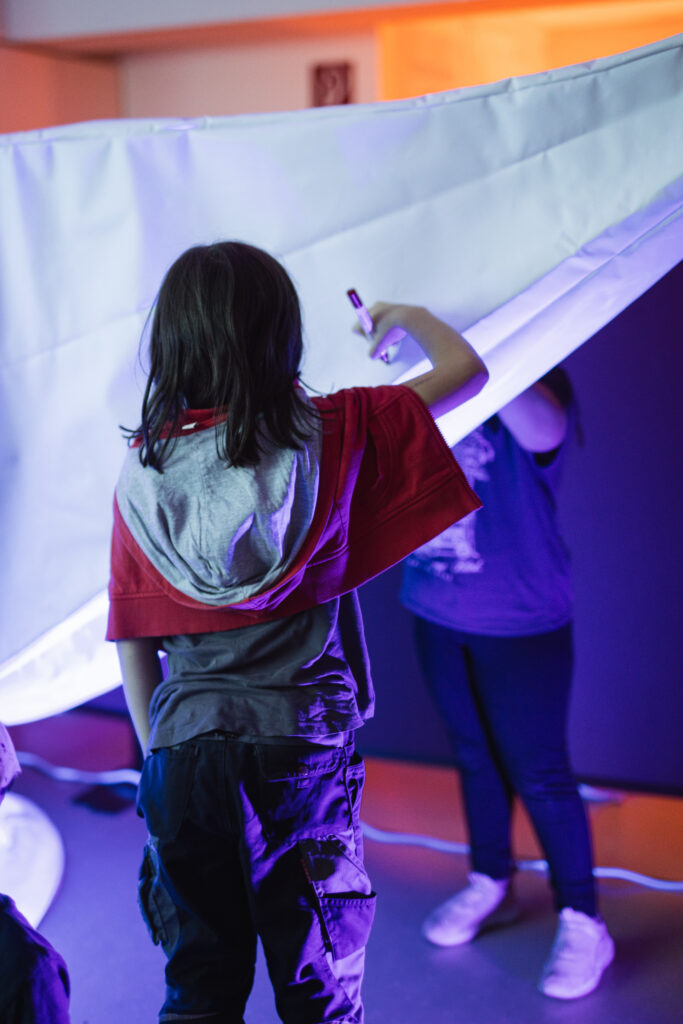
The Allen installation was highly effective and generated significant excitement, particularly through the use of UV lights and UV pens.
The magical quality of seeing drawings or marks appear under UV light created a strong sense of discovery. The children were naturally motivated to experiment and explore what they could create, demonstrating how the installation successfully used novelty, sensory stimulation and agency to encourage participation.
One practical safety consideration emerged during the session. Some children began drawing on their own skin with the UV pens. The facilitator therefore needed to monitor the activity and ensure that the marks were wiped off.
This is a useful example of why interactive installations designed for children require clear physical boundaries around open-ended exploration. The children’s behaviour was not necessarily inappropriate; rather, they were extending the invitation to create beyond the intended surface.
A future iteration could make the permitted drawing surfaces more visually obvious and provide an explicit instruction such as “Lets draw on the lamp behind you only”, potentially accompanied by a visual example such as lights directed at it. This could preserve the children’s freedom to experiment while reducing ambiguity.
If the pens are intended only for designated surfaces, this should be communicated through the environment rather than relying entirely on facilitator intervention.
KIDS’ ENGAGEMENT
Engagement with Allen was very high.
The combination of animation, mystery, music, UV technology and physical participation created multiple forms of stimulation. This variety appeared particularly effective in sustaining children’s attention.
The experience also demonstrated an important distinction between individual engagement and collective engagement. Children were highly engaged individually with the installation, but the strongest potential for social-emotional impact may come from bringing the children together at the conclusion.
The proposed format of having two groups experience the exhibition simultaneously and then combining them in Allen for the final dance party could create a powerful shared ending.
Rather than finishing the exhibition with children leaving individually, the dance party provides a moment of collective celebration and social connection.
This may be particularly beneficial for children who are initially shy or hesitant to participate. A child who might feel self-conscious dancing alone may be more willing to participate when surrounded by a larger group where movement becomes a shared activity.
The facilitator should therefore frame the dance not as a performance where children are being watched, but as a collective celebration where there is no “right” way to dance.
COLLECTIVE PARTICIPATION & CONFIDENCE
The proposed group structure has significant educational potential.
Having two smaller groups move through the experience and then come together in Allen creates a natural progression from smaller-scale participation to larger-scale collective interaction.
This can support several SEL competencies:
→ Self-awareness: becoming comfortable expressing oneself through movement.
→ Self-management: managing initial shyness or uncertainty.
→ Social awareness: noticing and responding to the energy of others.
→ Relationship skills: participating in a shared activity.
→ Responsible social participation: contributing positively to a group experience.
Importantly, the dance party should not require children to perform individually. The emphasis should remain on shared participation rather than individual performance.
This is particularly relevant when working with children who may experience social anxiety, self-consciousness or fear of judgement. A collective activity reduces the perceived spotlight on any individual child.
The room therefore has the potential to end the exhibition not simply with entertainment, but with a shared emotional release and celebration of participation.
SEL & EMPATHY OBSERVATION
Allen provides a different SEL opportunity from the more explicitly reflective rooms.
While Desiree and Frog can naturally facilitate conversations around emotions, belonging and perspective-taking, Allen creates an opportunity to explore self-expression, confidence, spontaneity and acceptance of others’ expression.
The genie introduces an additional metaphorical opportunity. The idea of something unexpected emerging from a hidden space can be used to encourage children to think about what is inside themselves that they may not always show others.
Facilitators could explore this gently through questions such as:
→ What surprised you about Allen?
→ How did you feel when the genie appeared?
→ Why do you think surprises can be exciting?
→ Is it easy to show other people how you feel?
→ Should we follow our hearts?
These questions can move naturally towards empathy without forcing children to disclose personal experiences.
The dance component can then embody the same principle: everyone can participate differently. Some children may dance enthusiastically, others may move quietly, and some may simply watch. All forms of participation can be accepted.
This creates an important anti-stigma message: difference in expression does not mean that someone is doing something wrong.
EDUCATOR’S REFLECTION
Allen was one of the strongest rooms in terms of energy, excitement and sustained engagement.
The combination of mystery, music and UV technology created a memorable experience, while the interactive elements encouraged children to move from observation into active participation.
The primary modifications are practical: provide clearer boundaries around the use of UV pens, consider a repeat option for the song, and optimise the final group structure.
The proposed two-group format followed by a combined Allen dance party could be particularly valuable. It transforms Allen from simply another exhibition room into a social climax to the overall experience.
Increasing the overall volume slightly could also enhance the atmosphere, particularly during the musical and dance components. However, sound levels should remain appropriate for children’s hearing and allow facilitators to communicate when necessary.
Most importantly, the final celebration should communicate that there is no correct way to participate. Children should be able to dance, move, sing, laugh, watch or join gradually without feeling judged.
In this way, the Allen room can reinforce a central SEL principle: confidence grows when people feel safe to express themselves without fear of judgement.
KEY RECOMMENDATIONS
Keep
→ The surprise appearance of the genie;
→ Strong musical component;
→ UV/magical visual effects;
→ Highly interactive installation;
→ High energy and engagement;
→ Collective dance ending
Modify
→ Add an option to repeat the song at the end;
→ Clearly identify the surfaces intended for UV drawing;
→ Consider child-safe visual instructions for the UV activity;
→ Slightly increase volume during musical/dance moments where appropriate;
→ Maintain the two-group format and combine groups for the final celebration.
EDUCATIONAL OPPORTUNITY
Use Allen as the collective emotional climax of the exhibition. The final dance can become an intentional SEL experience centred on self-expression, confidence, acceptance and belonging.
Rather than asking children to perform, create an environment where everyone can participate at their own comfort level. The larger group can help reduce the feeling of being individually observed and create a shared atmosphere in which children feel safer expressing themselves.
This gives the exhibition a powerful closing movement:
Experience → explore → express → connect → celebrate together.