

Reimagining Education in a Practice – Sodwana Bay Primary School Co-creation Workshop
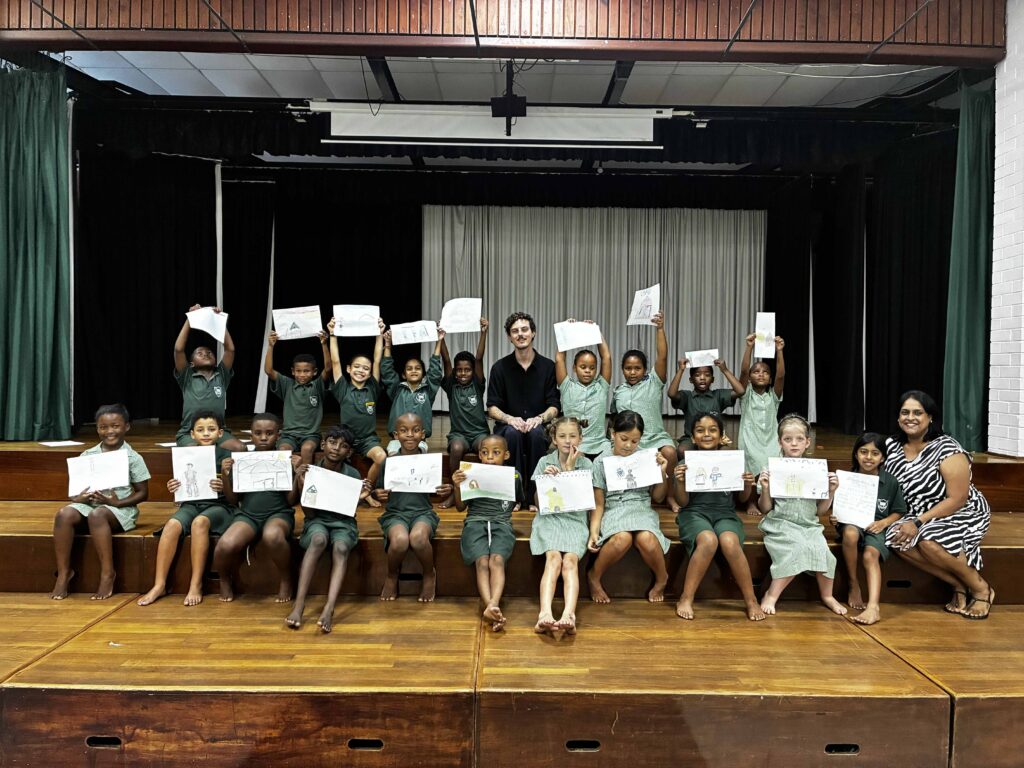
Sodwana Bay Primary School, Kwazulu-Natal, South Africa.
Story: Filip and the Paper Theatre and Cinda Real.
Age group : 7-9 Years.
Workshop Focus: Storytelling, Illustration, Emotional Literacy & Group Discussion.
The Twisted Tales workshop took place at Sodwana Bay Primary School, situated deep within rural South Africa, approximately four hours from the nearest major city. The surrounding cultural environment is rich, traditional, and community-oriented, with social norms and learning styles that differ significantly from urban school contexts.
The learner group was notably large and made up of different ages, which directly influenced facilitation choices and the effectiveness of certain workshop components. The toolkit was adapted to suit a variety of students’ needs, such as non-verbal children and a neurodivergent pupil who thoroughly enjoyed participating.
Group Dynamics & Literacy
Despite the size of the group, learners demonstrated strong literacy skills for their age group. They followed the story attentively, recalled narrative details accurately, and were able to describe characters and events clearly.
While narrative comprehension was high, learners initially struggled to fully grasp:
The intended message of the story.
The concept of stigma embedded within the narrative.
The abstract social themes being explored.
With gentle prompting, guided questioning, and peer-supported discussion, learners’ participation and willingness to talk were very high. This suggests that comprehension barriers were contextual rather than cognitive.
Emotional Intelligence & Social Awareness
Learners demonstrated high emotional intelligence (EQ) for their developmental stage. They could identify emotions within the story and showed sensitivity to characters’ experiences when prompted.
However, during emotional check-ins and circle sharing:
Learners frequently copied one another’s responses.
Many were reluctant to speak independently about feelings.
Emotional expression appeared socially mirrored rather than individually articulated.
This behaviour suggests a strong collectivist emotional framework, where group cohesion and social safety take precedence over individual emotional disclosure. Rather than indicating low emotional capacity, this reflects culturally reinforced norms around communication and hierarchy.
Illustration & Non-Verbal Engagement
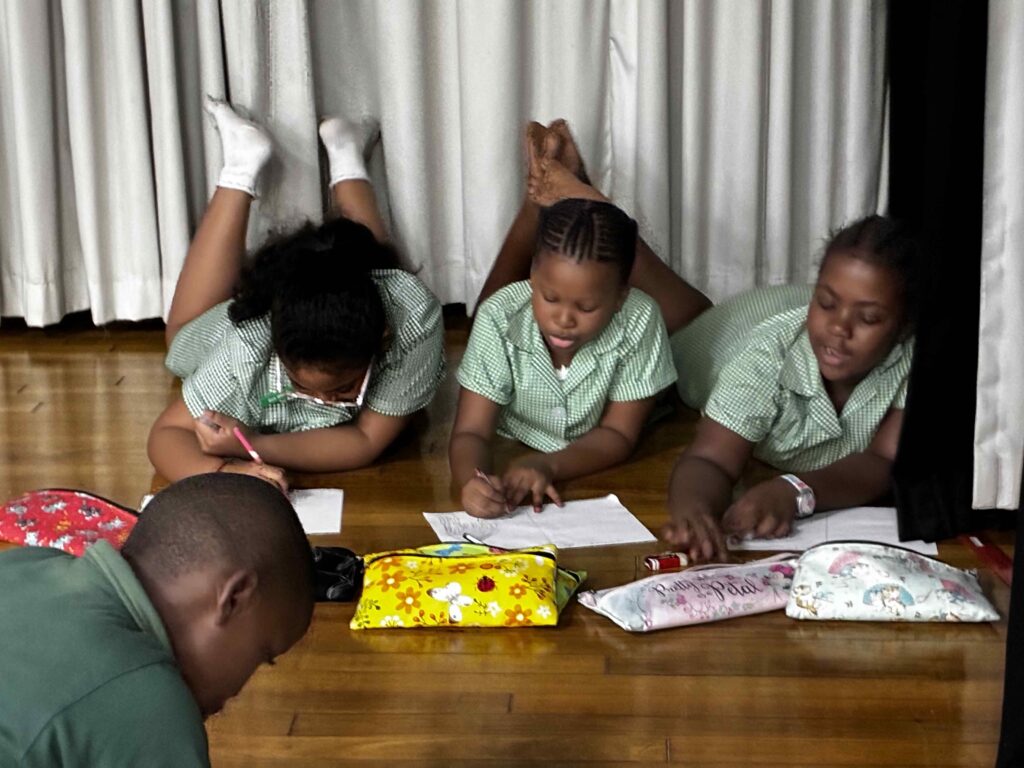
The illustration and acting components were the most successful and enthusiastically received element of the workshop.
Key observations include:
High levels of sustained engagement.
Independent creative decision-making.
Use of visual elements to express mood, relationships, and atmosphere.
Illustration functioned as a non-verbal emotional processing tool, allowing learners to explore complex feelings without the pressure of verbal articulation. This was particularly effective given the large group size and cultural context.
Acting, Embodiment & Group Size
Due to the large group size, acting-based activities were developed to act out emotions which helped facilitate empathy and openness for self-expression.
Embodied activities require smaller groups to ensure emotional safety and inclusion.
Acting was therefore scaled back and did not reach its full intended impact.
This highlights the need for methodological flexibility when working with large cohorts.
Methodology & Cultural Fit
Certain aspects of the Twisted Tales methodology did not initially align with the learners’ cultural and social context and trainers’ modified approach on the go, the varied emotional levels and social maturity allowed for new and varied approaches such as collective discussion and reflection, debate and empathetic reflection through open-ended questions.
Key observations:
Open emotional sharing felt unfamiliar and uncomfortable for many learners.
Individual self-expression was less accessible than group-based reflection, although through acting they became very expressive in regards to sharing emotions non verbally.
Some facilitation techniques assumed prior exposure to reflective dialogue practices.
However, once the discussion was reframed by workshop facilitators and supported collectively, learners were able to engage meaningfully and demonstrate understanding.
Key Challenges
Large class sizes, especially in rural areas.
Resource inequality between schools.
Language barriers.
Limited access to structured Social Emotional Learning (SEL).
Psychological Reflection & Cultural Considerations
From a developmental and cross-cultural psychology perspective, children in rural and collectivist contexts often benefit most from Social Emotional Learning approaches that:
Prioritise group reflection over individual disclosure.
Use creative and symbolic methods rather than direct emotional questioning.
Allow emotional understanding to emerge through shared discussion and activity.
Given the learners’ strong Emotional Quotient (EQ) alongside reluctance to verbalise feelings, this group is arguably especially in need of Social Emotional Learning (SEL), delivered through culturally congruent methodologies.
Psychological Rationale
Research shows that children are more likely to engage with social-emotional learning when:
Emotional exploration feels socially safe.
Learning methods reflect cultural norms.
Reflection is indirect rather than confessional.
By adapting methodology rather than content, Twisted Tales can maintain its psychological depth while increasing accessibility and impact.
Conclusion
The Twisted Tales workshop at Sodwana Bay Primary School revealed a group of emotionally intelligent, literate, and creatively engaged learners operating within a culturally distinct environment, where government funded schools lack resources meant to be provided by the state but excel in teachers who give their all for their kids and embrace them as their own, the teachers and Sodwana Bay Primary were extremely committed and driven to help facilitate our team and their learners through a meaningful exploration of ideas, feelings and topics.
While the story’s message and exploration of stigma were not immediately accessible, learners demonstrated clear understanding after discussion and guided support. Illustration proved to be a very effective engagement tool, while certain methodological approaches require adaptation for this context.
This experience reinforces a central insight:
SEL is most effective when methodology aligns with culture and group dynamics. In communities such as Sodwana Bay, where collective identity and tradition are strong, where care givers are usually Grand Parents or other family members as parents usually work in the cities away from their kids, Twisted Tales holds significant potential in exploration of emotions, life lessons and themes of strong role models — provided its methods are responsive to the learners it serves, through adaptations that are culturally and demographically centric, the workshop was a great success, it up lifted, empowered and challenged.