


What if fairy tale characters asked you for your help?
THE MAKING OF TECH TALES: from co-creating stories with children to designing an immersive storyworld
What if, instead of asking children to listen to a tale, we asked them to help its characters? This is the starting point of Tech Tales, our immersive storyworld for children that premiered this September at Vienna Design Week in Austria.
Created as part of a EU-funded project→ led by the Institute for Transmedia Design→ from Slovenia and including partners Art Rebel 9→ (Slovenia), the Vienna Design Office→ (Austria), the NGO FLUX→ (Montenegro), ART TRANSPARENT→ (Poland), Grupa Hajde da …→ (Serbia), IAAC – FabLab Barcelona→ (Spain), Tech Tales invites children to learn and discover through experience. Designed as an immersive exhibition that combines storytelling, animation, play and exploration, it introduces children to three characters, Allen, Frog and Desiree, and their stories about challenges that might sound surprisingly familiar: a dream that feels impossible, a child who is being left out, an unexpected friendship. At different points in their stories, the characters need help. Children are invited to draw, make sounds, or build elements, and their contribution helps the characters continue their story and find a way to overcome their challenge.
These playful acts of creativity and participation give children the opportunity to explore different ideas, emotions and points of view. In Tech Tales, a small twist in perspective can change a story, and a touch of curiosity can open up playful opportunities to talk about emotions.
From exhibition to storyworld
The exhibition explores themes of identity, belonging, friendship and the acceptance of diversity, but rather than explaining these ideas to children, we wanted them to emerge through children’s actions. We wanted to give them the opportunity to experience these themes through movement, drawing, building and storytelling. A child draws because Allen needs encouragement, builds something because Frog needs a solution, explores touch and sound because Desiree needs support. This interaction thus becomes the story itself, and it fosters curiosity in children and gives them the space to see things from another’s perspective with the overall goal of nurturing empathy.
Before Tech Tales
Before the exhibition even became an idea, we were learning to co-create. Tech Tales is part of Twisted Tales TV, a wider creative initiative, a transmedia platform built around participation and co-creation. From the very beginning we asked ourselves how we can include children in each step of the storytelling process. Building on a methodology that prioritizes social-emotional learning and child well-being developed through Twisted Tales TV in collaboration with experts in education, children behavior and psychology¹, the first step was to develop the stories.
¹the method was awarded the Sozial Marie prize for social innovation in 2019, and has since been upgraded based on feedback from children, educators and psychologists
From story to image, from image to sound, from sound to animation…
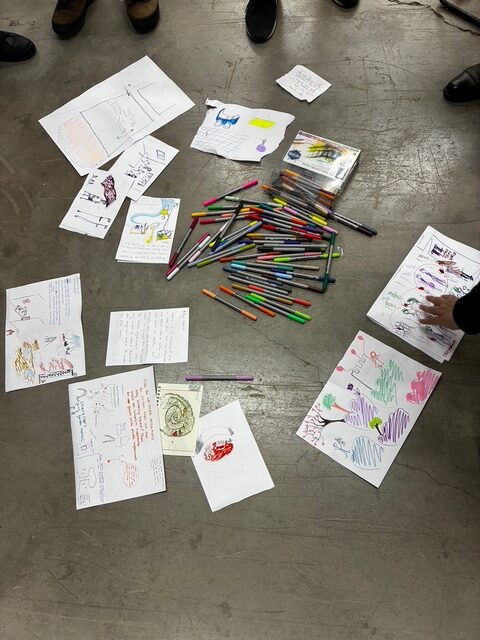
For the three tales used in the exhibition², we conducted several co-creation workshops based on the aforementioned methodology in which children participate in the creation of stories through a sequence of creative processes.
✹ Session 1: Storytelling → introduction to the narratives and themes
Here children are introduced to a fairy tale, they explore its central themes through active listening, discussion, and creative engagement. They are asked to give feedback and help develop the story.
✹ Session 2: Illustration → expressing stories through art
Here we encourage children’s creativity and visual storytelling by asking them to visualize characters, places and worlds from the tale.
✹ Session 3: Sound & voice creation → bringing stories to life with sound
In this session children learn about the power of sound in storytelling by creating voices, sound effects, and moods of the tale.
✹ Session 4: Immersion & animation → exploring movement and different perspectives
The last session is dedicated to transforming the story into a moving or performed experience, understanding how different perspectives shape narratives.
While more than 800 children participated in co-creation activities as part of the wider Twisted Tales TV programme, for the purpose of the exhibition, we conducted 12 co-creation workshops in 10 countries involving 410 children:
→ 12 co-creation workshops
→ 8 Creative Europe countries with 279 children involved
→ 131 children through additional workshops in India and South Africa³
→ 410 children reached altogether through the full workshop programme for the Tech Tales exhibition
²Allen and the Magic Lamp written by Miroslav Minić; Desiree and the Snow Queen written by Marko Pejović; The Princess and Her Frog Friend written by Kalina Maleska based on the script by Dora Vagić, Sara Božanić, Marie-France Blais, and Christophe Erbes.
³A design methodology or experience should not be developed around an imagined “generic child”, but through encounters with as many real children as possible in different contexts. That is why we wanted to involve children from outside the European context in the process by collaborating with schools in India and South Africa, as we believe that the decentralisation of European innovations and encounters with diverse cultural and social environments is crucial.
… and then to the visual world
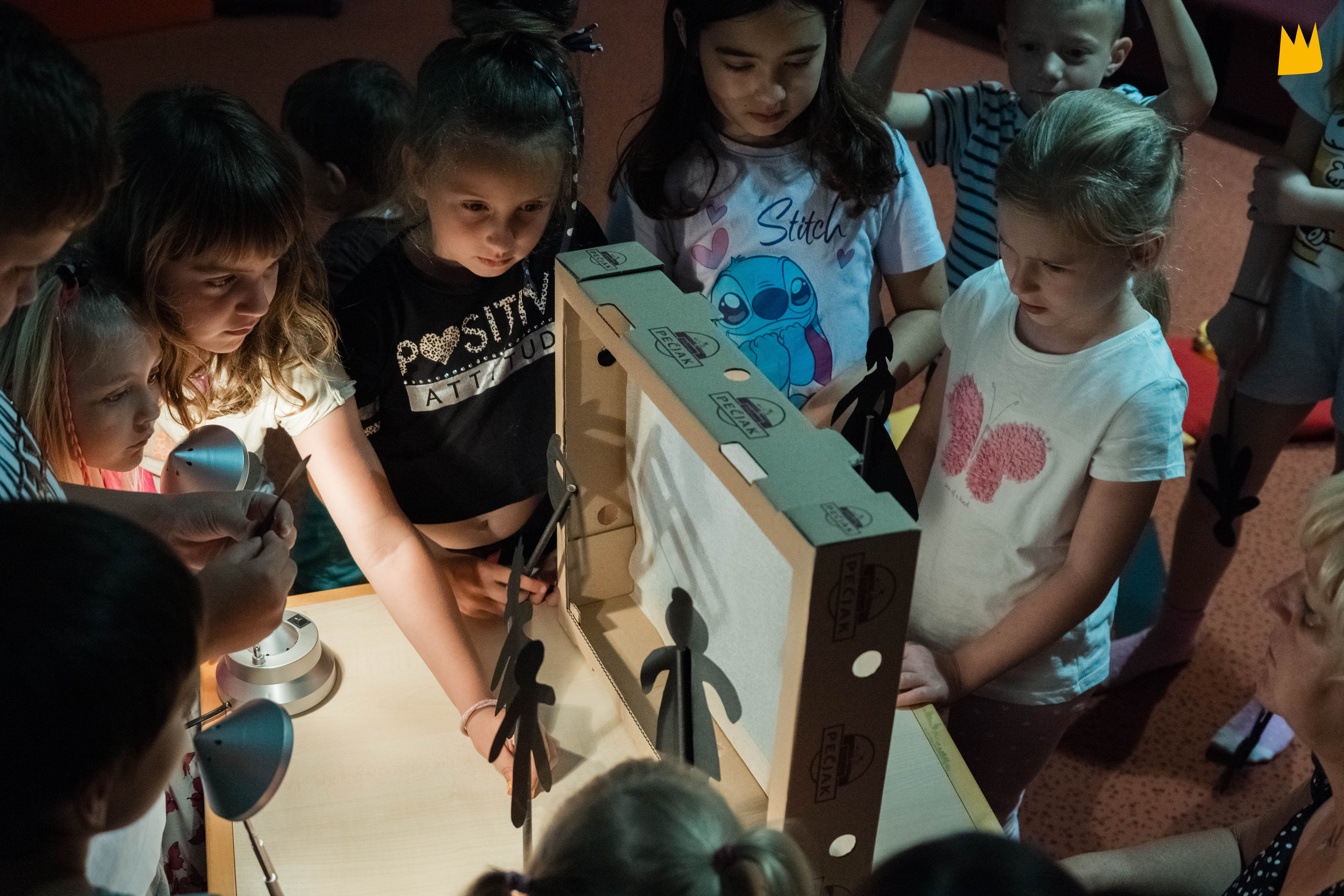
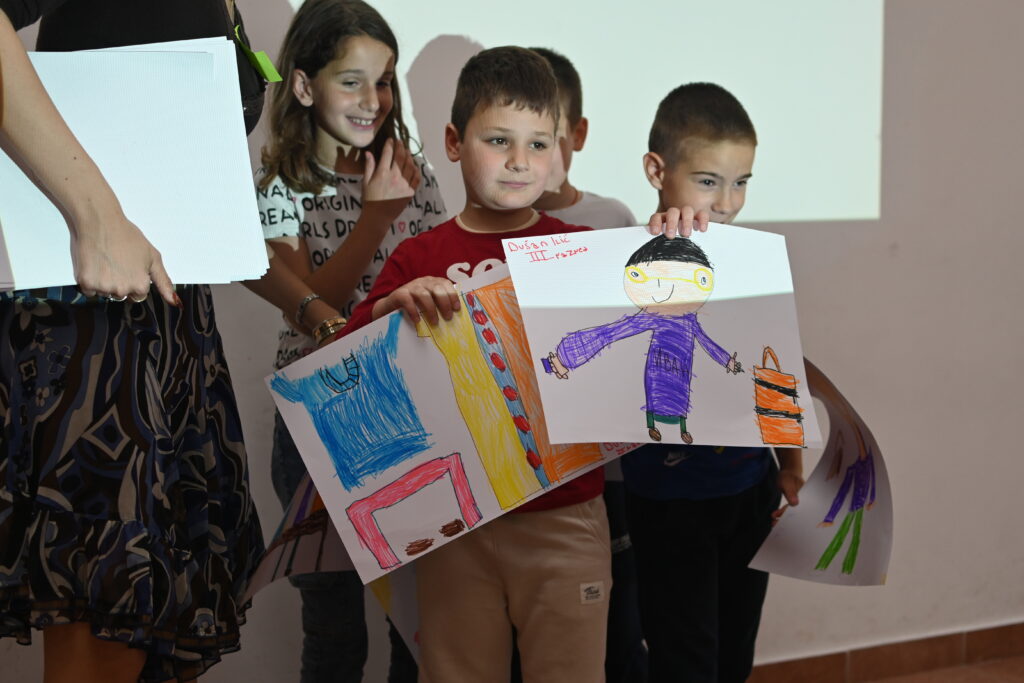
The children’s creative outputs became material for the storyworld itself. They were given to professional illustrators, and then to animators, and finally to sound designers who all drew inspiration from them and used their colours, shapes, sounds and patterns to create the final storyworld.
This process was not developed only for Tech Tales, as this exhibition represents only a single fraction of the larger Twisted Tales TV ecosystem where this method has been explored through different forms, such as audio tales→, animation→, AR books→ and relaxed theatre performances→. One of its early prototypes, Cinda Real, became a short animated film that was subsequently recognised and awarded internationally. Tech Tales takes this established process into a different medium, an immersive storyworld co-created with children for children.
So how do we turn all this into an experience?
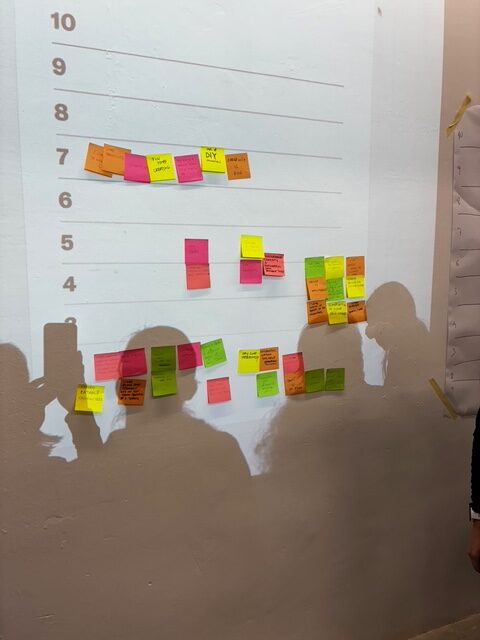
As co-creation is at the heart of our approach and given that our work lives through various media, a creative workflow is woven into our processes. Thus, we were developing the exhibition concept in parallel with the creative workshops. Putting ourselves in the role of a child, we asked ourselves: how would I want to experience these ideas? First, we designed the feelings we wanted to evoke from a child’s perspective, and then we moved on to design questions such as: how can we uphold children’s agency without over-explaining everything to them? After several group meetings and brainstorming sessions we came up with some design principles that would guide the experience:
✹ interactions should be intuitive and encourage curiosity:
we wanted the interactions to feel less like “What should I do?” and more like “What happens if…?” We decided that we did not want to give children explicit instructions and tasks with a correct answer and reward, but rather to create situations that encourage them to try, explore and discover what happens next;
✹ technology should empower children, not overwhelm them:
technology should play a supportive role in the experience and respond to children’s actions without becoming the focus of their attention. The focus should not be on what technology we should use, but what a given technology enables the child to experience;
✹ the emotional journey shall lead the experience:
the experiences should be shaped around an emotional arc: an introduction, a challenge, and a moment of transformation, connection or resolution, and children should be able to experience every stage;
✹ play comes before lessons:
we wanted children to experience the ideas conveyed in the tales through play and experience. A lesson might (or might not for some) arise through experience, but not through explanation.
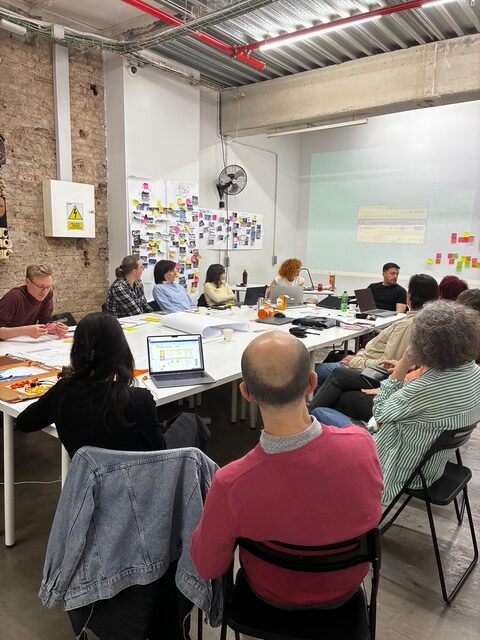
With these principles in place, we began developing the scenarios and emotional goals for each character and each tale.
✹ ALLEN: AGENCY / SELF-EXPRESSION
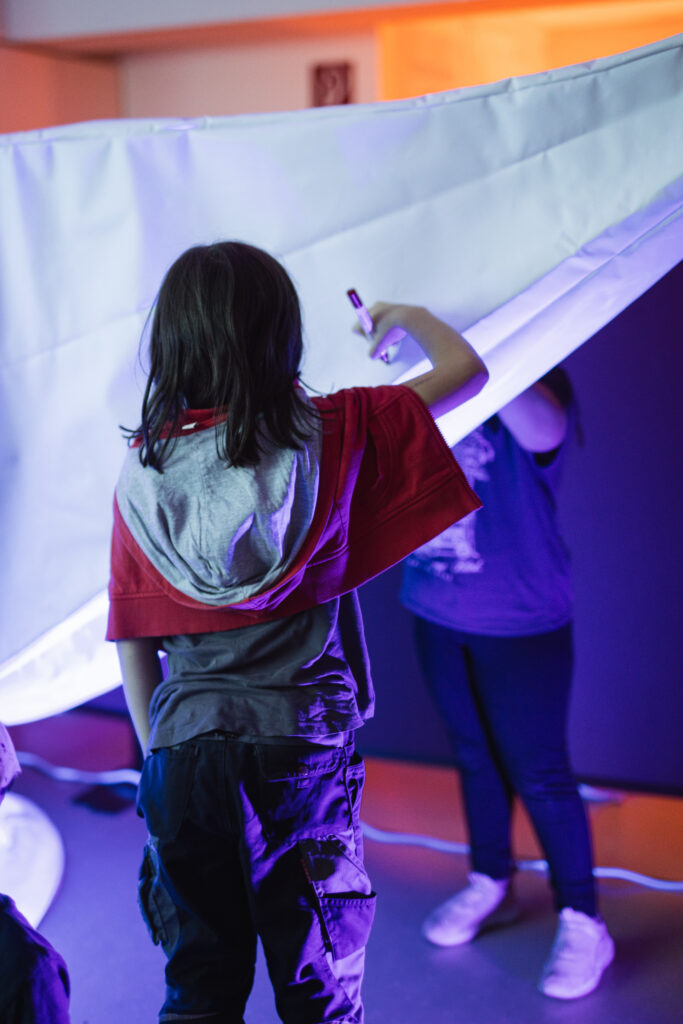
Allen’s experience is about discovering that his ideas and dreams deserve to be seen, and that bringing a dream to life also takes work, practice and effort. He is a boy who doesn’t want to be a footballer, as his father wants him to be, but rather a fashion designer. Children decorate a magic lamp with their own drawings using UV markers. At first, their drawings appear invisible just as Allen’s ideas once felt unseen, but when the UV light reveals their drawings, this step becomes crucial to the continuation of his journey, as Allen realises that his own path does not have to follow someone else’s expectations. The final interaction invites children to celebrate their own dreams through movement and dance.
✹ DESIREE: CONNECTION THROUGH DIFFERENCE
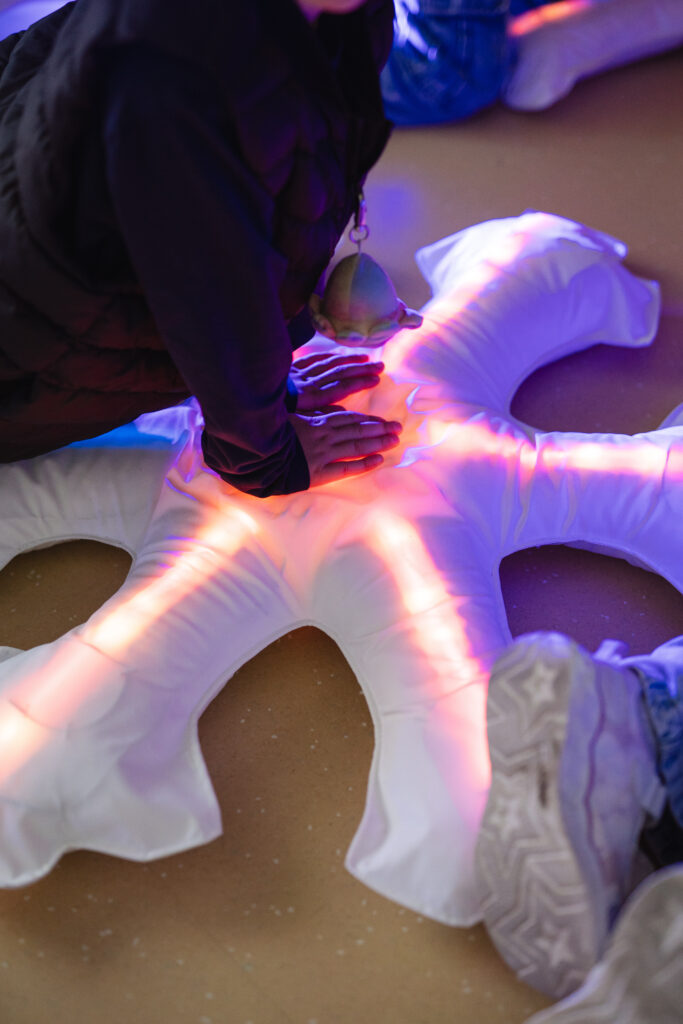
Desiree’s experience is about discovering that being different should not mean something bad, and that our differences can become a source of connection and belonging. Desiree is a girl with Down syndrome who sometimes feels isolated because she experiences the world differently from those around her. Desiree’s experience uses snowflakes as a metaphor for individuality and belonging. Children touch and listen to different snowflakes and discover that each one produces its own light and sound. As the story unfolds, some sounds become disrupted, reflecting Desiree’s experience of feeling isolated and out of place. In the final stage, through joint interaction with a single snowflake, children bring different sounds together, creating a beautiful shared musical experience. The technology makes the metaphor tangible: difference is not something to hide or eliminate, but something that should be celebrated.
✹ FROG: CHANGING THE WORLD RATHER THAN CHANGING MYSELF
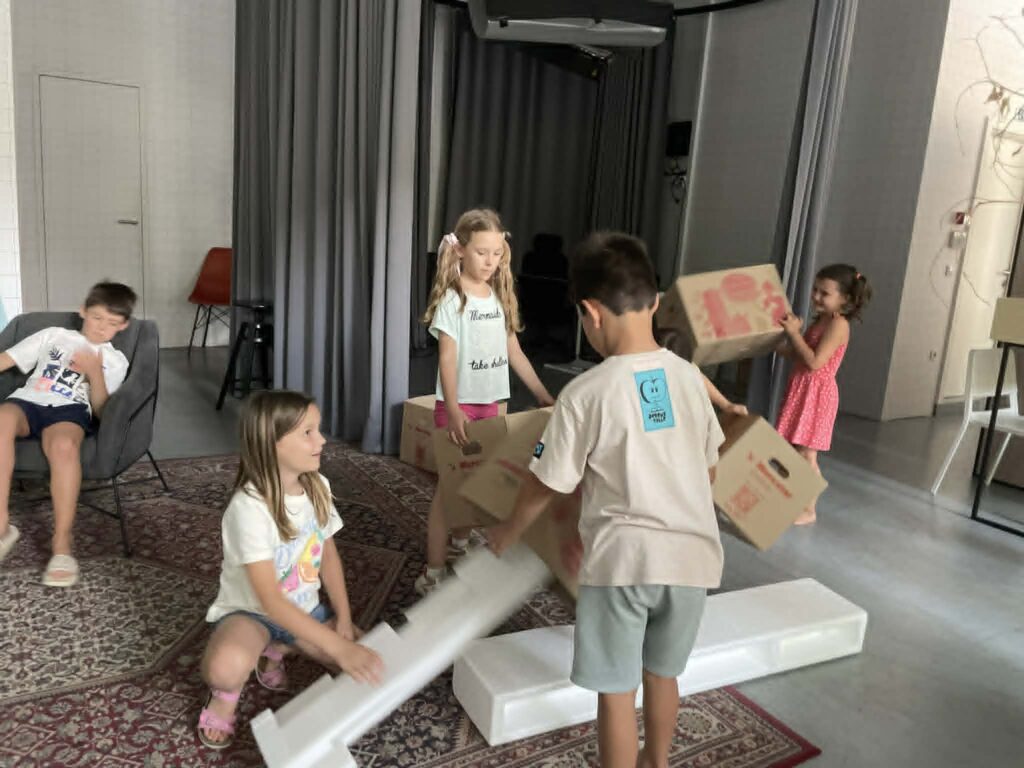
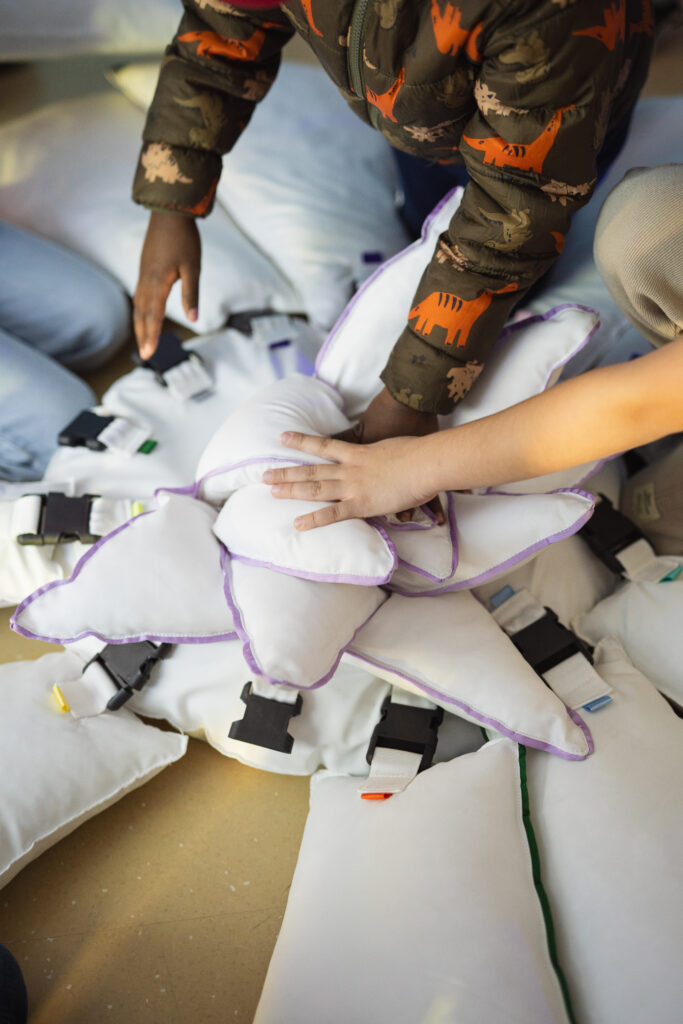
Frog’s story explores belonging across different worlds, and how we can find a sense of belonging without having to change who we are. Frog meets a princess and struggles with the feeling of needing to change in order to fit into her world. Here children assemble objects such as the lily pad belonging to the Frog’s world and a giant spoon resembling the scale and rules of the Princess’ world. Using objects with built-in sensors and clips so that the system can recognise when they have been assembled, once the pieces are put together, the action triggers the next part of the story. In the final stage, instead of turning Frog into a prince, they are invited to combine all the objects and create a completely new world together without following a predetermined solution. The interaction embodies the idea that, instead of changing ourselves to fit into someone else’s world, we can work together to create a world where everyone can belong.
What connects the three experiences is not simply the use of technology, but the way digital storytelling and physical interaction constantly feed into each other. Children watch an animated story on the wall, then respond to what they hear and see by entering the physical space and manipulating real objects, their actions trigger light, sound, projection and narrative reactions that bring them back into the story. They move back and forth between the projected world and the physical world, gradually no longer perceiving them as two separate layers but as a single, continuous storyworld. The boundary between watching and doing begins to disappear and the story becomes something they physically embody.
✹ A PLACE TO PAUSE
Going back to the question on how to respect children’s agency over the experience, we deliberately created a space for stepping out of it. A dedicated space for slowing down, resting and taking a moment away from the immersion. Here, children can relax, they can create stories of their own or explore how different emotions are expressed through a dedicated social-emotional learning game. This activity invites them to recognise and explore different emotions and try simple breathing exercises that can help them notice and manage moments when emotions become overwhelming. It can also serve as a starting point for conversations about emotions, giving children and the adults accompanying them an opportunity to explore these experiences together, if they choose to.
For us, agency also means being allowed not to participate and choosing when to enter, when to engage, and when to pause. This space gives children exactly that choice.
Back to children again
Designing for participation is deciding what to do and what not to do. To translate the scripts and ideas into an experience that would work from a child’s point of view, we tested our prototypes with children. Seven children became testers, experiencing different versions of the animation, dialogue, sound, interactions, timing, lighting and responsiveness. Their reactions and feedback brought us back to the design again, helping us produce an experience that really works for them.
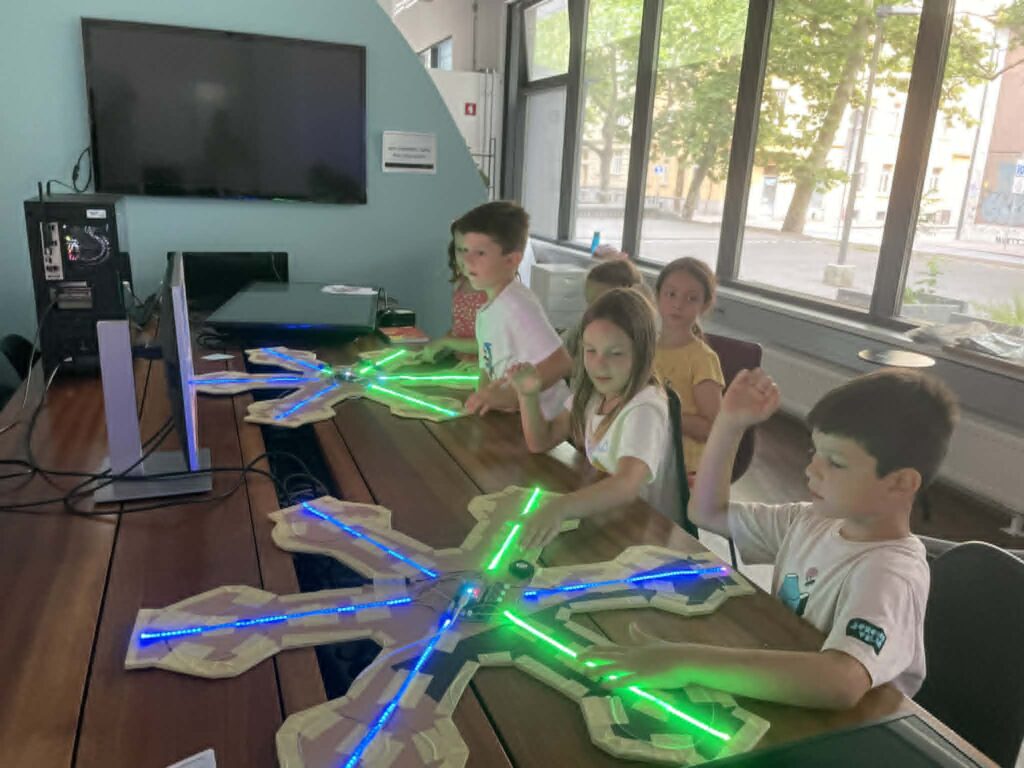
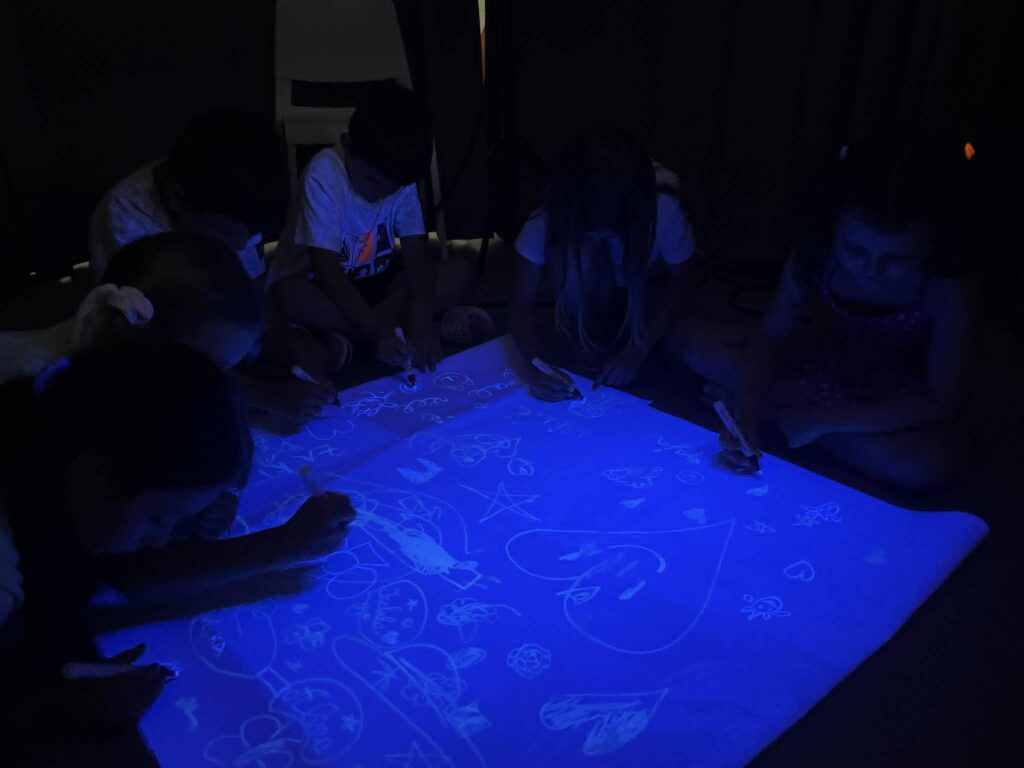
The physical layer was developed with equal attention to participation and care. Sensors are embedded into the objects and combined with familiar clips, similar to those children might recognise from school backpacks, allowing them to build, dismantle and rearrange the objects freely. UV markers and lighting make invisible drawings appear on a huge magic lamp that stands almost imposingly in the space, turning a familiar act of drawing into something unexpected and magical. Touch sensors transform physical contact into light and sound, while wall projections and audio connect these actions back to the animated story.
The objects themselves are made from recycled billboard materials, chosen for their softness, ease of cleaning and suitability for children, as well as their environmental friendliness. Alongside these, we also incorporated a number of existing props and objects, giving them a new role within the exhibition.
So what actually happens?
What actually happens when we invite children to help a story’s characters instead of just listening to them? From what we saw and experienced during the premiere at Vienna Design Week, a small but beautiful twist happens. A child enters expecting to listen to a story, but then the story stops and needs the child to become part of it. At that point, a twist occurs in the way the child experiences the story and perceives the challenges of others. And it is precisely at that point that empathy can grow: through interaction and connection, through an interest in other people’s experiences and through learning to recognise emotions in themselves and in those around us. Tech Tales gives children the opportunity to explore these aspects through their own actions rather than through instructions.

The Tech Tales exhibition was co-created by: Marko Pejović, Mateja Filipović-Sandalj, Matjaž Požlep, Nina Sever Plešec, Brane Herak, Larisa Nagode, Slavica Danić, Predrag Petrović, Boštjan Nagode, Ana Matić, Robert Aleksić, Alexandra Rauschgold, Gabriel Roland, Karolina Bieniek, Michał Bieniek, Magdalena Basak, Paweł Rogowski, Santiago Fuentemilla, Julia Leirado, Olga Trevisan, Sally Bourdon Julia Danae Bertolaso, Sara Božanić, Matej Končan – Kleemar, Oleg Morović, Aleksandar Popović, Ana Dimitrijević, Marko Dimitrijević, Suzana Krstić, Milica Ponjavić
The tale Allen and the Magic Lamp was written by Miroslav Minić and illustrated by Tom Schirdewahn.
The tale Desiree and the Snow Queen was written by Marko Pejović and illustrated by Milica Čvokić.
The tale The Princess and Her Frog Friend was written by Kalina Maleska, based on a script by Dora Vagić, Sara Božanić, Marie-France Blais, and Christophe Erbes and illustrated by Eulàlia Miró Batlle.
Co-creation workshops with children were led by: Maximilian Hissek, Nina Manhal, Maša Kontić, Lejla Abdić-Đoković, Milivoj Bometa, Kalina Maleska, Sara Božanič, Ana Kukoč, Julia Leirado, Santiago Fuentemilla, Magdalena Cichońska, Magdalena Młodzianowska-Chilmon, Metka Celec, Ana Ivanović, Ana Matić, Šenida Kajević, Ivana Kurtović, Anita Vujović, Edita Ličina, Ratko Šćekić, Marko Pejović, Milica Babić, Jayanti Tamby, Milivoj Bometa.
The Tech Tales exhibition is part of the project TECH TALES: TECH(ing) TALES WITH A TWIST for the children of the present co-funded by the European Union.